Thursday, 14 March 2013

Flora's Birthday Party

Most of my posts before have been about celebrating a child’s birthday with scrumptious food; however the Victorians had a different way of looking at food in association with childhood and I'm afraid it's not as light hearted and fun as in some of contemporary books I have looked at! Prepare yourself to see childhood in a not so innocent way...

Victorian children's literature was very overtly didactic compared to what we see these days and they saw childhood in a completely different light - some Mum's would be horrified to discover the meanings behind the innocent looking tales the Victorians presented to their children! Children's literature was seen as a means of social regulation and so if children’s reading was kept under strict control it would ensure their impressionable young minds would not be corrupted. This was especially relevant for girls who were thought of in the ‘traditional’ view of women who were passive and occupied the domestic sphere of the home. Carolyn Daniel states that the ideal Victorian woman was “a creature of disinterested love and nurture and the moral center of both home and society. To conform to this ideal, women and girls had to downplay every aspect of their physicality, including desire and appetite” (Daniel, 39). Thus, the significance of food and girls’ appetites used in children’s literature at the time had the implication of girls’ eating representing a sign of sexual desire. (In my mind I can see this fitting into our modern world where you get the chocolate bar adverts with the woman seductively eating a chocolate bar... making chocolate sexy and desirable!) Anyway, in the Victorian era openly didactic literature was used as a way to enforce social gender roles on girls and control the female appetite and desires.

The Victorians also linked food to a child’s morality for both boys and girls. They feared that food and fiction “considered to be bad for them in terms of being too rich for the physical body, or in poor taste in terms of being too fantastic for the rational mind,” (Daniel, 42) would cause excitement leading to “immorality and irrationality” (Daniel, 42). Thus, their food and fiction was closely monitored. (You could say we still monitor children's food today but for much less sinister purposes such as health reasons!)

An example of a text that shows the Victorian attitudes to childhood and food is Speaking Likenesses by Christina Rossetti which consists of three interwoven tales. The first is "Flora’s Story" about her birthday party. At the beginning she is depicted as the perfect, angelic child as she sleeps on the morning of her birthday: “her cheeks were plump and, her light hair was all tumbled, her little red lips were held together as if to kiss someone.” However, this all changes when the party comes around. The party is a disaster after the children quarrel over a “sugar-plum box,” turn their noses up at the party food, have a boisterous game of blindman’s buff, make each other cry and end up grumbling at each other. Flora also acts ‘superior’ as the birthday girl showing off her new doll and ends up “cross and miserable”.

Eventually Flora wanders off and enters a dream sequence where a birthday feast is taking place. However, she is not allowed to eat any of the food as the “birthday Queen” refuses to let her as she states “it’s my birthday, and everything is mine.” Despite this, all the other guests eat “greedily”. Flora notices that the children have odd appearances, one boy has “prickly quills like a porcupine,” another is covered in “hooks like fishhooks” and one girl “exuded a sticky fluid” whilst another was “slimy”. These monstrous appearances could be seen as allegories for the bad behaviour of the children at Flora’s party. The monstrosity of the children is furthered by their consumption of the food where they stuff “with no limit”:

“Cold turkey, lobster salad, stewed mushrooms, raspberry tart, cream cheese, a bumper of champagne, a meringue, a strawberry ice, sugared pine apples, some greengages”

The food is described as appetising and appealing yet Flora does “not take so much as a fork,” showing how she epitomises the good child of the Victorian era who shows control and good manners. In contrast to her, the birthday Queen is shown as the girl with an uncontrolled appetite as she,

“consumed with her own mouth and of sweet alone one quart of strawberry ice, three pine apples, two melons, a score of meringues, and about four dozen sticks of angelica.” 

This excess of eating shown through the listing, counting and size of the portions suggests she has a voracious appetite and emphasises the size of her mouth which has sexual connotations linking to Victorian concerns of female appetite being associated with sexual desire. Flora does not participate in the feasting showing that although desire to eat all the appetising food is created, she does not succumb to this as it is seen as immoral behaviour. So by the end of the story Flora has learnt a lesson that gluttony is a sin and that the female appetite must be controlled as suggested by the narrator:

“And I think if she lives to be nine years old and give another birthday party, she is likely on that occasion to be even less like the birthday Queen of her troubled dream than was the Flora of eight years old: who, with dear friends and playmates and pretty presents, yet scarcely knew how to bear a few trifling disappointments, or how to be obliging and good-humoured under slight annoyances.

Overall, "Flora’s Story" shows how a birthday party was used in children's literature of the Victorian era to present attitudes of the time and enforce these on children through the narrative as children were seen as creatures vulnerable to corruption. So count yourself lucky that you didn't grow up in the Victorian age and can eat as much as you like on your birthday without it making you corrupt! 

Daniel, Carolyn. Voracious Children: Who Eats Whom in Children's Literature. London: Routledge, 2006.

Rossetti, Christina. "Flora's Story". Speaking Likenesses. 1874. Web. About.com Classic Literature.
14 March 2013. 
http://classiclit.about.com/library/bl-etexts/crossetti/bl-crossetti-speaking-fl.htm

Tuesday, 12 March 2013

Back to Matilda

Bruce Bogtrotter's Cake at the Theatre

I recently saw Matilda The Musical at the Cambridge theatre and was particularly interested in how they presented the food on stage after writing my post about Bruce Bogtrotter’s Cake.

As I suspected the cake was not real, like in most theatre productions but what really caught my attention was how they presented the eating of the cake.

The theatre adaptation changes the scene and in the musical Trunchball does not know it is Bruce that has eaten her cake but only finds out through a ginormous burp he lets out whilst she is in the middle of accusing a different character. The "disgustingly chocolatey" burp is described as floating round the class room reaching each child’s nose and then finally Trunchball’s, who then realises who the cake thief is. The description of the burp and the character’s animated expressions of disgust shows the revolting side of food, how it is consumed and what bodily effects it can have which is not always shown in adult literature but can often be found in children’s books like Roald Dahl’s. In children’s stories it seems more acceptable as the description is funny for children as there’s something about the revolting that makes children squirm and giggle, which it certainly did at the Cambridge theatre! This shows how writer's connect food and the disgusting with entertainment, especially for child audiences.

If you want to see how this scene is acted for yourself, I recommend going to see it at the Cambridge theatre but you could also watch the scene in the film adaptation.


Monday, 4 March 2013

Pandamonium - Part 2

21st Birthday

It may not be my 6th birthday but I can still have fun party food for my birthday if I want to!
  
So as my birthday was on the 28th February my Mum and I decided to try and make panda cupcakes as mentioned in my previous post.

We didn’t stick to one recipe in particular but instead used ideas from what we had seen online and in the Hello, Cupcake! recipe book and made a mixture of panda heads and full size pandas.  

This is what we used:

Standard cupcake mix – When mixing this with the electric mix my Mum had not learnt her lesson from making reindeer cakes and we ended up with the mixture exploding all over the kitchen again!

Butter icing – To cover the cupcakes. The Hello, Cupcake! recipe recommends using vanilla frosting; however we could not find any ready-made frosting in our supermarket so had to make our own. The only problem with this was that our icing was more yellow than we would have liked because of the butter used. So our panda’s fur was a rather off-white!

Marshmallows – Hello, Cupcake! recommends sticking mini marshmallows to the top of the cupcakes with the icing to create a point for where the panda’s nose goes and then cover the marshmallow with frosting when covering the rest of the top of the cake.

Oreos cut in half – For the ears.

Poppets – For the noses.
Piped black icing – We used black food colouring to make the icing for the mouth and eyes.

Chocolate chips – For the eyes.

Piped white icing – For the eyes and claws.

Mini cupcakes – For the heads of the full size pandas

Crushed Oreos – For the fur on the body of the full size panda as suggested in Hello, Cupcake!

Chocolate buttons – For the ears of the full size pandas.


Here’s how they turned out:

We also added decorations to make them into a proper birthday cake and of course grass, for the authentic 'panda in the wild' look!

Although, these cakes are not featured in any children’s books you could take inspiration from a children’s picture book based on animals for a party theme as there are many out there. For example:

Elmer by David McKee
Frog by Max Velthujis
The Very Hungry Caterpillar by Eric Carle
Monkey and Me by Emily Gravatt
Michaela Strachan’s Really Wild Adventures by Michaela Strachan

Using the different animals kids discover in picture books you could have a zoo or farm themed party and have a different food based around each animal such as rainbow biscuits in parrot shapes, sandwiches cut into elephant shapes and the possibilities to make cupcakes with any animal are endless as presented in the Hello, Cupcake! recipe book. Having an animal theme for a young child’s party would also help with their learning of how to identify the different animals and their names which is often taught in picture books. This shows how children's literature can be used as inspiration for the food created for kids and can be educational too.

Wednesday, 27 February 2013

Pandamonium - Part 1

Pandas are one of my favourite animals and after making reindeer cakes I really wanted to try making a panda version. I love animals, which a lot of children do too so I thought animal themed cupcakes would be a great idea for a party.

I had a few ideas myself of how to make panda cupcakes such as with Oreos for ears and I also had a browse on the internet to see what else I could find. Turns out they are a popular style of cake to make as I found many different versions, for example on this website:


Then my Mum borrowed a cupcake recipe book from a friend which had an amazing recipe for how to make them. Here's a bit about the book...

Hello, Cupcake! By Karen Tack & Alan Richardson.


This New York Times Bestseller states it has “Irresistibly playful creations anyone can make”. This is perhaps questionable as the book presents an array of elaborate cupcakes ranging from horse shaped ones to others decorated like roast dinners. To an inexperienced baker the challenges the book presents could be quite scary! However, in the ‘Cupcaking Techniques’ chapter the book gives detailed descriptions and lots of images demonstrating the methods used in the recipes included. So if you are enthusiastic to learn then the book is a good place to start your cupcake making adventure. The recipes are also easy to follow but as the book is American certain suppliers suggested to get the ingredients from are not available in the UK. 

This book is a great source to get many ideas for party cakes that children would love; so as the book states “find a project that tickles your fancy, grab a bag or two of candy, and get ready to put your smile into overdrive. It’s time to get this party started” (1). 
:)


I  too did what they said and got prepared to make panda cupcakes using the 'Pandamonium' recipe which you’ll see the results of in my next post!


Karen Tack & Alan Richardson. Hello, Cupcake! New York: Houghton Mifflin, 2008.

Sunday, 24 February 2013

Birthday Cakes

The most important part of a birthday party that kids wait all year for!

I remember I loved choosing which cake I was going to have at my party and spent ages looking through my Mum’s recipe books. I guess most Mums just chose the cake for their child, but I was a rather fussy one! My Mum has always been very creative with making cakes and let me have fancy ones!

Here’s my 1st birthday cake, (of course, I wouldn’t have had a say in this one!)


 My favourite book to choose my cake from was Cakes for Kids by Sarah Stacey. Sarah starts the book with an informal introduction using a friendly first person narration that makes you feel more comfortable with the idea of trying to make elaborate cakes as she speaks of having “little experience,” (5)  and no “formal training,” (5) in cake making herself before writing the book. She states that she hopes the “book makes it clear that producing wonderful cakes can be fun and fast,” (5) and appeals to the parent as a busy person that may not have time to make amazing cakes yet will be able to use this simple guide to do so. She also refers to children in her introduction stating that she talked to them and went to their parties where she found out “Having a better cake than you friend whose party was last week is very important” (5). Thus, she establishes the importance of birthday cakes yet makes them also sound not so daunting to make!

Further into the book Sarah provides all for the novice baker, stating detailed lists of what equipment to use and presenting basic recipes of how to make cake bases such as a Victoria sponge. She also says how to use each ingredient individually when icing cakes. She then provides the reader with recipes for the different cakes which are set out in sections ‘Quick and Easy,’ ‘Easy but not as quick,’ ‘Not to be rushed,’ and ‘Non-birthday,’ which makes it simple for the reader to identify what challenge with cake making they would like to try depending on their skill and how much time they have. Each recipe either comes with stencils on the page for the decorations used or they are included at the back, such as basic lettering to save time in drawing out your own. Also the recipes all start with a little anecdote about who she made the cake for and why which adds a personal tone and shows she has really made all the cakes and tried them out on real children. Overall, from my Mum’s experience of making cakes from this book she thinks the book is easy to use and the tone Sarah uses is also reassuring telling the reader that it “ doesn't matter,” if this or that happens as she is there guiding you along the way with detailed suggestions of how to do everything. However, it’s probably not the best recipe book to use with kids as the cakes are not ones you want any little fingers messing up!

 
(The computer cake shows the age of the book as it was printed in 1986 so computers are a lot more advanced then this now!)

These are 2 of my favourite cakes my Mum made from this book:

Marshmallow Garden – This is cake decorated with lots and lots of sweets which makes me think of the book The Secret Garden by Frances Hodgson Burnett as it is like a special garden just for the birthday girl! I do have a photo of this but the non-existence of digital cameras at the time means the quality is shocking!

Top of the Pops – The “chocolatiest,” (24) of cakes! My Mum slightly adapted the recipe and used a real CD on top.


There is a story behind this cake too much like the stories you find in food memoirs which goes like this…

One party, One cake, One dog

It was my 7th birthday. My party for this year was at the Frontier Post; the only western themed restaurant in Bexleyheath. I don’t know why I chose that venue; I didn’t have a particular interest in cowboys and Indians. I was more the colour pink and Barbie’s little girl. But my special day couldn’t arrive sooner. I’d invited everyone in my class, as tradition at primary school but also family. My grandparents and auntie and uncle had come down from Chester especially for the party. Unfortunately, the only member of the family that would be missing out on some birthday cake was our sheepdog, Susie – we didn't think the restaurant would appreciate an animal guest!
        On the day of the party, full of beans, I got ready. My birthday outfit was a long, beige, camouflage, maxi dress with a split up the side from Debenhams. It was made from polyester that clung to my skin. I thought it was so fashionable. My signature hairstyle was wacky with plaits, twirls, twists, clips, grips, fluff and sparkle. Today was no exception. My long, auburn hair was scattered with lots of sparkly, flower shaped clips and tied back with one big hair band with red, blue, green and orange pom poms on it, holding the master piece together. In our flowery hallway I posed away for the Kodak disposable camera. My little monkey face beamed with joy at being the birthday girl.
        The cake was the real star of my party. My mum had slaved away in the kitchen making an extra chocolately birthday cake. I looked through her recipe book, ‘Cakes for Kids,’ for hours and chose a different one each year. A traditional Victoria sponge cake from Marks and Spencer would NOT be good enough. This year she made a music themed, round chocolate sponge, covered in thick chocolate butter cream icing and sprinkles, topped with a real CD in the middle and tiny silver balls around the outside. The chocolate obsessed monster inside me couldn't wait to eat it. So you would think I had the first bite of the oh so anticipated birthday cake… but no, I didn’t.
        Her super smelling doggy senses must not have been able to resist the rich, indulgent chocolate smell. She’d been waiting for the perfect chance to have her wicked way with it. Just her and the cake alone in the room. Would this dog have a very full belly?
Yes.
        My mum screamed and scolded Susie. The beautiful cake had a big chunk missing. It was now being digested by a naughty sheep dog. Susie was not invited to my next birthday party.

And if you wanted to know, my Mum did manage to save the rest of the cake and fix it!


Stacey, Sarah. Cakes for Kids. London: Elm Tree Books, 1986.

Tuesday, 19 February 2013

What's Sweet and Wobbly?

JELLY

Yes, the traditional party food typically associated with children. A fun and easy to make dessert! Why fun? Because as any child would tell you… it’s bright, sweet and wobbles when you poke it! Even the name jelly has a fun sound to it!

So I decided to make jelly as it’s an important type of food that generally comes up on a party food menu and also features in children’s literature such as in ‘Milly-Molly-Mandy Gives a Party’.

I bought a jelly mould and 2 sachets of jelly crystals from my local supermarket which came to the grand total of £1.60, so a very cheap party delicacy to make. The packets I bought were sugar free and had no artificial colours or flavours so are slightly better for kids and their teeth!


The ingredients and preparation


I followed the instructions on the back of the packet which involved adding the crystals to half a pint of boiling water, stirring them until they dissolve, then adding half a pint of cold water and pouring the mixture into the jelly mould. I then let it set in the fridge for 6-8 hours.

Now removing it from the jelly mould was a challenge! I thought I was going to end up with mashed up mess of wobbly red stuff but I managed to save it! After looking up advice on the internet of how to get your jelly safely out of the mould I discovered these tips helped: Poke a knife down the edges of the jelly mould to ease it out and you can also try placing it in a bowl of hot water for a few seconds before attempting to empty the contents on to a plate. In the end my jelly made it out of the mould only a bit disfigured! I decorated it with bananas, cream and cherries to make it more appetising. I also discovered that it probably wasn’t best to use a black plate as it doesn’t show off the bright red colour that the jelly is. Oh well, I’m no Delia Smith, even if it is only jelly! But my Mum did tell me that it is notoriously hard to get a jelly out of its mould!

Here is my wibbly, wobbly strawberry jelly…

Served like this in a sundae dish or even just a bowl the jelly looks like a tasty, appealing desert to serve at a children’s party and I’m sure kids would love the messy, colourful, wobbly appearance anyway!

An example of how jelly is used in children’s literature as a typical party food is in the Milly-Molly-Mandy Stories (1928). I loved these books as a little girl and can remember reading them all the time before I went to bed. There was a map of Milly-Molly-Mandy’s village in the front sleeve of my edition which I always used to look at and imagine her and her friends going on their adventures!

In the story, ‘Milly-Molly-Mandy Gives a Party,’ Milly-Molly-Mandy and little-friend-Susan decide to host a party; however they do not have enough money to buy the refreshments. So they start their own business, “Millicent Margaret Amanda & Susan & Co.,” (81) where they sell “bunches of flowers,” (81) “clean brass,” (81) and “run errands” for a very cheap price. As a didactic narrative this story teaches children the value of money and how to earn it yourself. Even if it is only running little jobs it still enforces ideologies of business and commerce. The story also teaches children, in particular girls, the skills of being a hostess. The girls simple attempt at hosting a party involve them having “clean hands and paper cups and aprons,” (88) and then welcoming their guests with a “marigold,” (88) for each gentlemen’s buttonhole and a “pansy,” (88) for each lady. This shows that the text promotes basic manners and cleanliness. Then there is the main feature of the party which the girls have been saving up for, the refreshments: “raspberry-drops and aniseed-balls on saucers trimmed with little flowers; and late blackberries on leaf plates; and sherbert drinks, which Billy Blunt prepared” (89). This shows the girls sweet yet childish attempt at party food, they haven’t made any amazing food you would get at a grown-up party but they have tried their best with what they can do at their young age and with the little money they have. This presents how hostess skills and cookery are being promoted towards girls through the text as Milly and Susan are the ones that organise and prepare the party; whereas their male friend Billy just deals with the drinks and the music which could been seen as the less domestic, feminine jobs. Finally, the ultimate dish that Milly and Susan make is the jelly, which like mine comes from a packet! However, it does not go very well and has “to be eaten rather like a soup, as it wouldn’t stand up properly” (89). This comic result portrays the child-like element to the party but suggests that as they are children it doesn’t matter as at least they have tried and all the adults humour them by saying they “enjoyed the jelly so much” (89). In relevance to my own jelly-making this scene shows how hard it is to make jelly even though it seems simple enough to make that even a child could do it! Overall, the significance of the organising of the party and the making of the food in the story shows how the didactic narrative provides lessons for children and in particular enforces gender roles as Milly and Susan inhabit the domestic sphere of the female as hostesses.

Lankester, Brisley, Joyce. Milly-Molly-Mandy Stories. London: Puffin, 2011.

Thursday, 31 January 2013

Bruce Bogtrotter's Cake

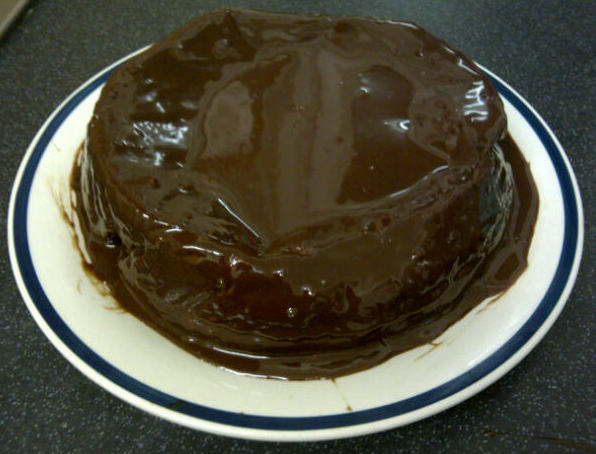
“The cake was fully eighteen inches in diameter and it was covered with dark-brown chocolate icing” (118).

Roald Dahl’s books are filled with enticing yet also disgusting descriptions of weird and fantastical food from Glumptious Globgobblers to Boiled Slobbages. There is even a  Roald Dahl cookery book, Roald Dahl’s Completely Revolting Recipes, which is filled with instructions on how to make the interesting and sometimes disgusting sounding foods from Dahl’s books and actually make them taste yummy! It is a fun cookery book for kids with many simple and straight forward recipes that they can help along with in the kitchen. Much of the food would be perfect for kids’ parties and you could even have a party on the theme of one of Dahl’s books such as Charlie and the Chocolate Factory. The book recommends a great menu for a kid’s party on page 112. I decided to make the suggested birthday cake using the recipe for Bruce Bogtrotter’s Cake from Matilda.

Ingredients
  • 225g good quality plain chocolate (although I did use milk chocolate, it was cooking chocolate and worked fine!)
  • 175g unsalted butter, softened
  • 225g caster sugar
  • 4 tbsp (60 ml) plain flour
  • 6 eggs, separated
 Coating:
  • 225g good quality plain chocolate 
  • 225g double cream 

  1. Preheat oven to 180°C/gas mark 4.
  2. Grease and line the cake tin with greaseproof paper.
  3. Melt the chocolate in a pyrex bowl, over saucepan of a simmering water or on a low heat in a microwave.
  4. Mix in the butter and stir until melted.
  5. Add the flour, sugar and lightly beaten egg yolks.
  6. Whisk the egg whites until stiff.
  7. Gently fold half of the whites into the chocolate mixture, mixing thoroughly.
  8. Then carefully fold in the remaining whites.
  9. Cook for approx. 35 minutes. There will be a thin crust on top of the cake, and if tested with a skewer the inside will appear insufficiently cooked but don’t worry as this is the character of the cake and it gets firmer as it cools. This cake is deliciously moist and light.
  10. Leave to cool in the tin on a wire rack.
  11. When cool enough to handle remove from the cake tin and discard the greaseproof paper.
  12. In a pyrex bowl over a saucepan of simmering water melt together the chocolate and cream, stirring occasionally until the chocolate is fully melted and blended with the cream.
  13. Allow to cool slightly.
  14. The cake is prone to sinking slightly in the middle so place upside down for coating. (My cake definitely sunk in the middle!)
  15. With a palette knife spread the chocolate coating all over the cake.
  16. Allow to set in a cool place before serving.
Recipe from: Dahl, Felicity, Josie Fison and Ann Newman. Roald Dahl’s Completely Revolting Recipes. London: Jonathan Cape, 2011.

Here’s my results

Why not add some smarties to make it more colourful for a birthday cake and don't forget the candles!

This cake is a mouth-watering piece of party food and I’m sure anyone can see how Bruce Bogtrotter in Matilda cannot resist eating Miss Trunchbull’s private cake from the kitchen which is described as being “rich and delicious,” (116) and made from “real butter and real cream” (115). Miss Trunchbull decides to punish him for stealing her special chocolate cake at an assembly in front of the whole school. She gets her shrivelled looking cook to produce an eighteen inches in diameter version of the cake and gives Bruce the challenge of eating all of the giant cake as punishment for his gluttony. Here food is used as a punishment. Amazingly, Bruce manages to eat all of the cake and triumphs in the “battle between him and the mighty Trunchbull” (124). Thus, using food as a punishment backfires on Trunchbull and only angers her more! Instead Bruce’s triumph over Trunchbull deems him a hero to his fellow students who cheer him on, “Well done Brucie! Good for you, Brucie! You’ve won a gold medal, Brucie!” (125).

From: Dahl, Roald. Matilda. London: Puffin, 2007.


As a recipe for a birthday cake Bruce’s cake can be used for further celebrations but hopefully at parties instead of as a form a punishment used by Headmistresses who put little children in the chokey!!